Thursday, 16 September 2010

Mary’s suitors – Part I: The Dauphin, François

In 1554, Mary married the most eligible royal in Europe. Wealthy, heir to numerous lands, handsome and chivalrous, Philip was the ideal candidate. He was also family, and we know how keen Mary was to preserve links with her Habsburg relatives. Mary did not marry for love; she had never met Philip before agreeing to marrying him and though she quickly became devoted to her husband, her choice was based primarily on his connections. In fact, the newly crowned Mary was more interested in Philip’s father, Charles V, who she had once been betrothed to (until he discarded her for Isabella of Portugal, Philip’s mother). Charles politely declined. He was, he argued, a rather old man, tied down with numerous problems across his vast empire. But he offered her his son and Mary readily accepted.


Throughout her life, Mary had been betrothed to, or there had been talk of her being married off to, the most prestigious figures in Europe. Despite being repudiated as heir to the throne in 1533, Mary was still regarded as a promising marriage candidate. This is part one (of what will probably be many!) posts looking at the men Mary was linked to.


François, Dauphin of France


Name: François, Dauphin of France

Parents: Francis I of France and Queen Claude (Francis’s first consort and the daughter of Louis XII of France who, incidentally, had once been married to Mary’s aunt, the ‘other’ Mary Tudor).

Position: The Dauphin; eldest son of the King of France and thus heir to the throne.

Live span: 1518-36

Qualities: Was heir to the throne of France; a great catch!

Faults: Dropped dead in 1536, a significant impediment.


The moment Mary was born speculations regarding her marriage were discussed. She was not the boy Henry and Katherine desired, but the appearance of a healthy baby gave the couple hope that a brother would soon follow. In the very early years of her life, marriage negotiations were somewhat ambiguous in nature, for they treated Mary as princess but were vague on her position as heir. Naturally those who sought her as their bride were quite excited by the prospect that Mary could be queen and they the king of England.


Dauphin François was betrothed to Mary at a very young age. In fact, he was still contently growing in his mother's womb when Henry and Francis I vaguely discussed a marriage between Mary and the child Queen Claude carried. Claude’s other children were daughters so like Katherine she faced pressure to deliver the necessary prince. Thankfully she had more luck than the English queen, and on 28 February 1518, François was born. In October, the Treaty of London was signed establishing ‘Universal Peace’ and promising Mary to the future king of France. Two betrothal ceremonies were held, one at Greenwich on 5 October, and the other in Paris on 16 December.


On 5 October, two-year-old Mary was taken to court and presented to the French ambassadors for the betrothal ceremony. The man standing in for the groom was Guillaume Gouffier, Lord Admiral of France. Wearing a gown of gold cloth, a small black cap to cover her auburn hair, and covered in jewels, Mary initially stood in front of her mother until the ceremony when she had to be held up to participate. The French ambassadors asked the royal parents for their, and thus Mary’s, consent which they duly gave. Then Mary’s godfather, Cardinal Wolsey, presented a magnificent diamond ring that was placed by the Admiral on the toddler’s finger. Mary was on her best behaviour but the event was naturally confusing for the child. She assumed the Admiral was her future husband. “Are you the Dauphin of France?” she asked. “If you are, I wish to kiss you.”


Portrait of The Lord Admiral by Jean Clouet, c.1516. Musée Condé, Chantilly


Shortly after, she was returned to the comforting world of the royal nursery, where her lessons in French would soon begin. Even by the end of her life, Mary’s proficiency in French was excellent and she conversed to her eventual husband, Philip of Spain, in this language. Her progress, and especially the state of her health, was carefully monitored by the French representatives at court. She only had few occasions to be displayed to them, namely in 1522 when Francis sent several diplomats to check up on the princess who was residing in Richmond. She entertained them by playing the virginals, performing with great skill for someone of her ‘tender age’. Yet she never visited France, nor ever met her intended husband.


Henry’s alliances with the French were always uncomfortably made, unsurprising given his desire to conquer rather than befriend them. Katherine, a Spanish princess, was horrified by the prospect of a French marriage for her daughter. Her father had once been engaged in a heated war with France, continued by his grandson and Katherine’s nephew, Charles V. She had been sent to England in 1501 to marry the prince of Wales, and help foster good relations between her native country and her adoptive one. This was the task of sixteenth-century foreign princesses – to act as ‘royal breeding machines’ (to coin a famous Tudor historian’s words!) and as diplomats. Mary’s engagement to the Dauphin signified Katherine’s failure. The same year she gave birth to a stillborn daughter; it would be her last pregnancy. 1518 must have been one of the bleakest years of Katherine’s life.


Fortunately for Katherine, Henry began to lose interest in the arrangement. Queen Claude dutifully sent an image of little François for his in-laws and bride to admire, along with a beautiful jewelled cross worth six thousand ducats. But Henry was reluctant to be so benevolent in return. Significantly, he failed to bring Mary to the Field of Cloth of Gold in 1520, though Francis and Claude brought the Dauphin with them. It came as no surprise when, in 1521, Henry broke off Mary’s engagement to the Dauphin and betrothed her instead to Charles V. The dauphin had been ditched.


Minature of the Dauphin by Jean Clouet, c. 1525-8. Royal Collection


Alliances were always feeble in nature and eventually the arrangement with Charles broke down. The English got a taste of their own medicine when in 1525 Charles married another cousin, the incredibly wealthy Isabella of Portugal. By 1526 a French marriage looked like a good prospect again. Unfortunately Francis had arranged another marriage for his heir, or to be more specific, it had been forced on him by Charles V. On 14 February 1525, Francis was captured in battle against the imperial forces at Pavia and to secure his freedom the French government sought an exchange – Charles may have the custody of Francis’s two eldest sons if he released the King (and the boys remained in captivity for around four years). Out of these talks came an agreement to marry the Dauphin to Charles’s niece Maria of Portugal and, given the unreliability of the English, the French regarded it as fair game to marry off the Dauphin elsewhere.[1] Thus by 1526 the Dauphin was no longer an option but Francis had other sons and he proposed that his second, Henri, duc d'Orleans, marry Mary. There was also talk of Francis being considered given that Claude had died in 1524.


Dauphin François and Mary were never betrothed again. In the mid 1530s there was some talk of a possible marriage between himself and Princess Elizabeth, Henry VIII’s daughter by Anne Boleyn, which came to nothing. On 10 August 1536, the Dauphin died suddenly at Tournon, an incident widely, and wildly, attributed to poison, resulting in the execution of one of his servants, Sebastiano de Montecuculli.[2] François’s death paved the way for his brother, Henri, to succeed to the throne. Henri was another of Mary’s one time ‘fiancées’. He would also turn out to be her main enemy.


Portrait of the Dauphin by Corneille De Lyon. Date unknown though seems mid-1530s


[1] Maria of Portugal was the daughter of Charles’s sister, Eleanor, who married Francis I in 1530. The marriage was one of the terms Charles forced upon the defeated Francis.

[2] François is said to have died after drinking contaminated water after building up a thirst playing a game of tennis. Tennis was a dangerous game for French royals. Charles VIII of France knocked himself out whilst playing the game, an injury which led to his death, and Louis X was said to have died after drinking large amounts of cold water after playing tennis for hours in the heat. Ironically, François’s brother, Henri (who became king in 1547), also suffered a sports-related death. This time it wasn’t the curse of tennis, but the ever dangerous pastime of jousting. A lance pierced Henri’s right eye and entered his brain. Physicians tried to save him but after ten agonising days he succumbed. In short, French royalty should never play sports.

Monday, 13 September 2010

A guide to Winchester

A few days ago, I visited the city of Winchester for the first time. Winchester is a particularly special place for the subject of this blog for, in July 1554, Mary married Philip of Spain in the fine cathedral. Here is a (very!) brief guide of the Mary sites in Winchester that will hopefully prove useful to anyone planning a visit:


Winchester Cathedral


Philip arrived at Southampton on the 19 July 1554. He stayed there for a few days, reaching Winchester in the early evening of 23rd. Soon after, he celebrated mass at the cathedral, then retired to the Dean’s house, changed dress, and went to Wolvesey Palace to meet Mary for the first time. Winchester’s proximity to Southampton, and the splendour of the cathedral, made it an ideal setting for the wedding. Additionally, the couple were to be married by the bishop of the diocese – Stephen Gardiner, the Lord Chancellor. The favourable comments made about the cathedral from Spanish visitors attests to the success of Mary’s decision to hold her special day there.


The couple married on 25 July, an auspicious date for it marked the feast day of St James, patron saint of Spain. The groom wore white and gold and the bride wore purple and white (sounds ghastly, I know! But from a contemporary perspective the couple were dressed magnificently). Philip’s ‘suit’ was a gift from his bride, who had spent quite some time arranging her own dress. Clearly she was determined to see Philip – the new King of England – as well turned out as she.


When visiting cathedral today, it is hard to fully appreciate the setting of the wedding for the couple married on a specially constructed scaffold that was removed shortly after. Two days earlier, they had met for the first time and this had also been a public affair. We are told that another sort of a stage had been constructed (this time in Wolvesey’s Palace, a short walk from the cathedral), where the couple first greeted each other in front of their receptive, and rather large, entourages. Thousands crammed into the cathedral for the ceremony, so the platforms proved handy. Along the nave a raised walkway had been built so the grand procession could be visible. This was no shabby affair. The cathedral was covered in ‘ryche hanginges’ and two sumptuous chairs were placed in the quire where Mary and Philip would sit during points of the ceremony. As the officiating herald recorded,

First the said Church was richlie hanged with Arras and cloath of gold, and there was a stage made along the bodie of the Churche that is to saie from the west dore untill the Rode Lofte wheare was a mounte made of iiii degrees of height as large as the place wold serue. The Stage and Mounte covered with Redd saie and underneath the Rode Loft was there ii trauerses made, one for the quenes Matie. on the right hand an other for the Prince on the left side. The which places served very well for that purpose. The quier was aloft hung with rich cloath of gold, and on eche side the high Aulter was there a rich Trauers one for the queen on the right side another for the Prince on the left Side.’


None of the rich cloth that adorned the cathedral has survived. Yet, if you go into the Triforium Gallery (in the South Transept) you will see ‘Mary Tudor’s Chair’. This sixteenth-century seat was allegedly the one used by Mary during her wedding.


Remarkably, throughout the ceremony Mary was placed on the right and Philip on the left, a reversal of the traditional situation. Mary presented herself as the active monarch with Philip as her consort. Naturally this caused some murmurs though, on the whole, both English and Spanish commentators explained away this situation and presented it as perfectly normal.


Bishop Gardiner began with a sermon, then asked the congregation whether anyone knew of any lawful impendent why the pair could not marry which, thankfully, no one decided to provide. Mary had no father to give her away and in theory she was to be given on behalf of the whole realm. The Marquis of Winchester and the earls of Arundel, Derby, Bedford and Pembroke, represented the people and answered Gardiner’s request as to who was to give the lady away. When they replied that they represented the whole realm, the crowd gave a cheer and acknowledged their acceptance of the marriage. Rings were then exchanged – Mary famously asking for a plain band – and Philip gave Mary gold coins which she handed over to Margaret Clifford (her first cousin once removed), who was attending upon her. They then celebrated mass at the High Altar. The ceremony was over; now it was time for ‘triumphing, bankating, singing, masking, and daunsing, as was never seen in Englande heretofore’.


Whilst in the cathedral make sure to check out Stephen Gardiner’s tomb. Unfortunately his effigy was spoiled by parliamentary troops in the seventeenth-century. The magnificent tomb of Cardinal Henry Beaufort, is relatively intact. Beaufort was the son of John of Gaunt by his mistress, then wife, Katherine Swynford. He was the great-uncle of Margaret Beaufort, Mary’s great-grandmother. Mary’s paternal grandmother, Elizabeth of York, is represented in a stained glass window in the beautiful Lady Chapel (which also features some amazing sixteenth-century murals).


Bishop Gardiner's tomb


Bishop Gardiner’s effigy which has been beheaded


The cathedral charges a small fee for entrance and photography is free (though prohibited in the library). It was one of the friendliest cathedrals I have ever been to and it is easy to spend hours in there. Jane Austen, one of my favourite authors, is buried in the Nave. Austen once remarked of Mary:


‘This woman had the good luck of being advanced to the throne of England, inspite of the superior pretensions, Merit & Beauty of her Cousins Mary Queen of Scotland & Jane Grey. Nor can I pity the Kingdom for the misfortunes they experienced during her Reign, since they fully deserved them, for having allowed her to succeed her Brother — which was a double piece of folly, since they might have foreseen that as she died without Children, she would be succeeded by that disgrace to humanity, that pest of society, Elizabeth. Many were the people who fell martyrs to the protestant Religion during her reign; I suppose not fewer than a dozen. She married Philip King of Spain who in her Sister's reign for [sic] famous for building the Armadas. She died without issue, & then the dreadful moment came in which the destroyer of all comfort, the deceitful Betrayer of trust reposed in her, & the Murderess of her Cousin succeeded to the Throne – '


Wolvesey Palace (aka ‘Wolvesey Castle’ and the ‘Old Bishop’s Palace’)


Wolvesey Palace is a short walk from the cathedral. Only ruins are left, but it is still worth exploring. For it was here, on the 23 July 1554, that Mary and Philip met for the first time. Philip arrived in Winchester on the same date, and moved into the dean’s house. Mary had only recently settled in the palace. Dressed in a ‘cloke of blacke cloth embrodred with silver, and a paire of white hose’, Philip proceeded to the palace with a huge retinue. Mary was waiting on the constructed platform which she ‘descended, and amiably receaving him, did kisse him in presence of all the people’. After what must have been a somewhat uncomfortable first meeting, witnessed by a large crowd, the couple retired to the presence chamber with prominent lords and ladies in attendance. One of the first challenges was figuring out how to communicate. As a young girl, Mary had been fluent in her mother’s native tongue. Now, she was no longer confident in her Spanish. So Mary spoke French whilst Philip replied in Spanish. They talked for some fifteen minutes after which Philip returned to his apartments. Before retiring he turned to the noblemen present and declared “Good night my Lords all”. It was the first and last time he spoke English. One of his companions alleged that he returned to the palace at ten at night, where the pair met once more, this time with fewer witnesses.[1]


The East Hall (the audience chamber). The wedding banquet was held here.


The palace was also the scene of the banquet and celebrations that commenced after the marriage service. Mary spent the first days of married life in seclusion (as was seen appropriate) and it is probable that she remained within the palace.


The palace is now owned by English Heritage and is free to enter. The presence chamber is clearly marked; walking through the main archway, it is situated in front of you.


Great Hall and Round Table


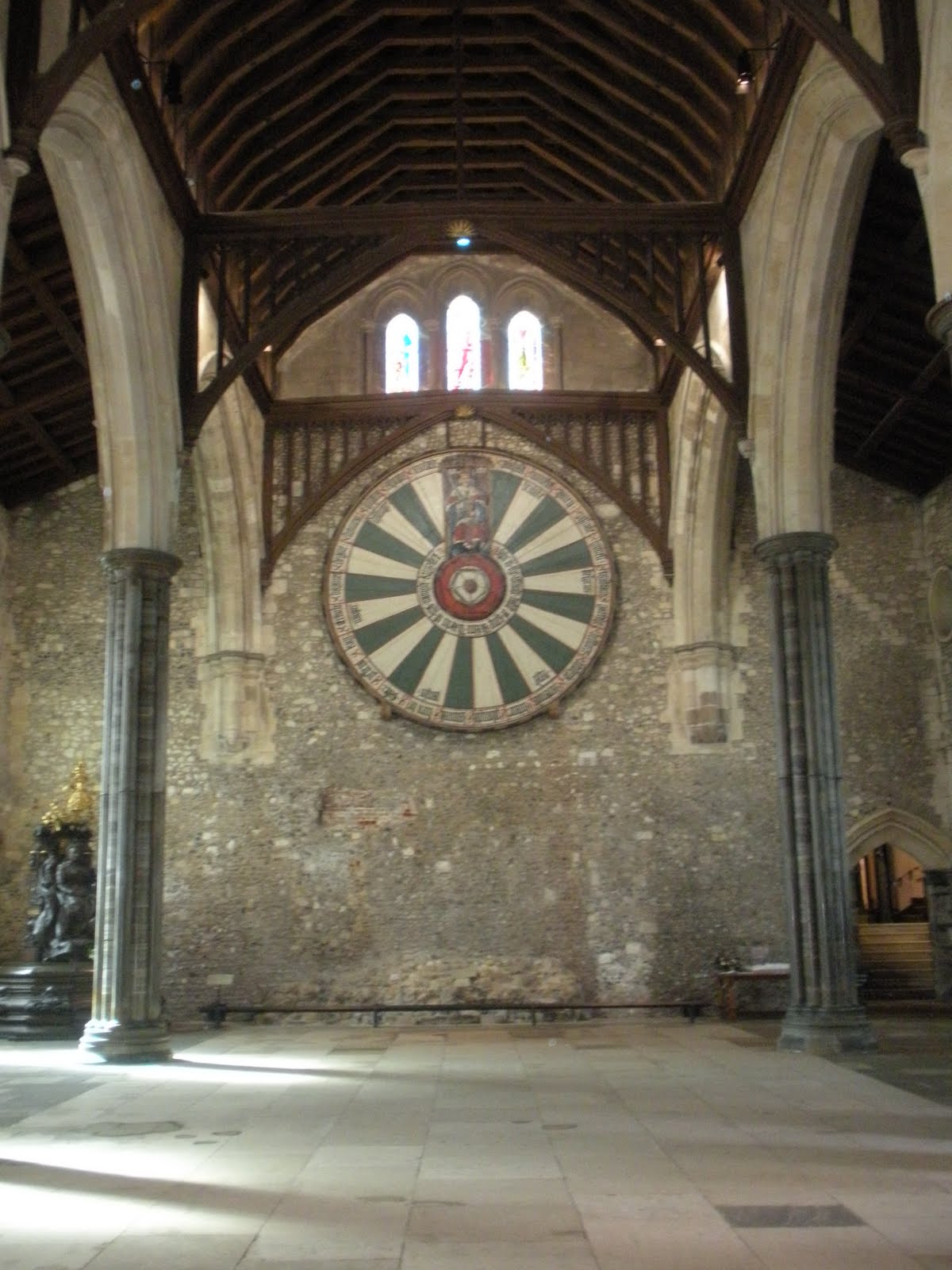
In 1522, Charles V visited England for six weeks. During the course of his stay, a betrothal was arranged between himself and the six-year-old Mary. As his arrival was celebrated in London, Henry VIII decided to take Charles to Winchester so he may see ‘King Arthur’s round table’. The table was constructed in the thirteenth-century by Edward III and painted in c.1516-7 (hence why King Arthur looks so like Henry!). Mary and Philip stayed in Winchester for several days after their wedding, and it is unknown whether Philip was show the table. However whilst Mary remained in seclusion following the wedding, Philip toured Winchester and it seems highly likely that he saw the town’s star attraction. The Great Hall remains a popular tourist site. Free to enter, it contains a magnificent set of nineteenth-century stained glass windows depicting the arms of individuals of importance to Winchester. Mary and Philip’s are included.


The Great Hall is free to enter and photography is permitted.


Westgate Museum


Westgate, one of the two surviving medieval fortified gateways in the city, is now a small museum and holds some interesting items. John White, Warden of Winchester College from 1542 to 1554, commissioned a splendid painted ceiling for his apartments that may have been ordered to celebrate Mary’s marriage. Mary and Philip visited the College after their wedding though it is unknown whether they saw the ceiling, or if it was specially made for the occasion.


Following conservation, the panels were given to the museum. Westgate also holds a portrait of Ralph Lamb, a wealthy resident of Winchester, who attended the wedding. The portrait is by an unknown Spanish artist and dates to c.1554, thus was commissioned to mark the event. He is probably depicted in the attire he wore for the occasion.


The museum is free to enter provides spectacular views of the city from the open rooftop.


[1] It is often stated that only one meeting took place. However one of Philip’s companions, Juan de Figueroa, mentioned another meeting at night.


(I have been working on the content for the Mary bibliography site, mentioned in my last post. I am not particularly computer savvy, so if anyone could give me some tips about which site I should use to create the website, I would be very grateful. Preferably something that I will find easy to use!)

Monday, 23 August 2010

Some updates


Apologies for the lack of updates. I am currently writing my dissertation (due in less than a month!) and the last weeks have been dedicated to this alone. When I have [finally] finished it, I will discuss some of my findings here as I came across some intriguing information.


Giles Tremlett, The Guardian's Spain correspondent, has written a biography on Katherine of Aragon. He will be attending the Cheltenham Literature Festival (16th October), which I attend annually so I should be able to go. If you can’t make it to Cheltenham, don’t fear – Mr Tremlett will also be speaking at Hampton Court Palace on 11th November. Fellow HRP members, we can get a bit of discount on tickets.


Its early days yet, but I have decided to start a new site which will, hopefully, be of use to students and nonstudents alike. It will basically be a bibliography of works on Mary, cataloguing books, articles, PhD and MA theses. I will divide studies up into sections (so a list of biographies, of works relating to the Marian Church, Marian government, art under Mary, music, etc...). I may even develop this further by adding primary sources as this summer I have worked extensively in the British Library and the National Archive and have become familiar with documents relating to Mary between the years c.1533-1553 (a little give away about the time frame of my dissertation!). I would love feedback about this. If you feel such a site would be useful, please say; if you think it is pointless, tell me. I have got lists of works saved on my computer for my own use but if this will prove useful to anyone else, student and other Mary enthusiasts, then I will gladly post them. I also have a number of magazine articles that I could post there. I will provide links to journal articles, including those that do not require subscriptions to see (which are, admittedly, just a handful!). So please tell me what you think. In the meantime, if someone is working on a Mary related project now and needs some guidance with reading materials, don’t hesitate to contact me.

Tuesday, 3 August 2010

A Mary themed tour of London!

I moved to London last September and sadly will be leaving this lovely city in two months time when my degree finishes. But I have made great use of my time here, visiting all those spots which I failed to before. Fortunately I grew up less than two hours away from London and visiting frequently allowed me to become familiar with the capital before I decided to study here. But there were still places I failed to visit, including those associated with Mary. Many visitors to London wish to spend their time at the famous landmarks and with a limited time in the capital this is entirely understandable. But there are other areas which are rather neglected and worth a visit too – some are even free to enter (a rarity in London!). So here is a brief list. Just to point out some were not part of London in Mary’s day but are now, so I’m counting places that constitute today’s city.


1. Greenwich

As the place of Mary’s birth, Greenwich fully deserves it places on this list of Mary related London sites. The palace where she was born (also the birthplace of Henry VIII and Elizabeth I) and the adjoining Church of the Observant Friars where she was christened are long gone. But Greenwich is still a great tourist hotspot. The Discover Greenwich centre has recently opened and various sixteenth-century artefacts are on display (though the focus is very much on Henrician and Elizabethan Greenwich). The park, where Henry VIII often went hunting, was a familiar site to Mary. Be sure to check out St Alfege Church which is about 5 minutes from Cutty Sark tube station. Though much amended since Mary’s day it is the burial place of the great sixteenth-century composer, Thomas Tallis, who served in the Chapel Royal under Henry VIII, Edward VI, Mary and Elizabeth. The church also holds the ‘Tallis keyboard’ which contains several sixteenth-century keys that were allegedly played by Tallis and the princesses Mary and Elizabeth.


The 'Tallis Keyboard'


2. St Margaret’s Church, Westminster

Located right by the abbey, this church admittedly has little in connection to Mary. But it is worth going in to see the stained glass window depicting a young Henry VIII and Katherine of Aragon. The window was commissioned by Henry VIII in the 1520s and was given as a gift to Waltham abbey, but shortly after the break from Rome it was confiscated by the King and placed in the chapel at Beaulieu. Beaulieu, otherwise known as New Hall, was one of the properties Mary inherited from her father and was one of her favourite residences. So the window was once her property and something she would have known well. It was relocated to St Margaret’s in the eighteenth-century. Entrance is free but photography is not allowed.


Detail of Katherine of Aragon in the stained glass window in St Margaret's


3. The National Portrait Gallery

Though small, the Tudor galleries in the NPG are a delight. See the c.1544 portrait of Mary – the first portrait she commissioned of herself, to mark her re-inclusion in the succession. There is also a miniature of Mary by Lucas Horenbout which depicts her wearing a brooch with her then betrothed’s name on it (Emperor Charles V). Room one is a collection of portraits of Mary’s family – a posthumous portrait of her mother can be found here, along with a fabulous painting of Katherine Parr that was misidentified as Lady Jane Grey for many years. But no Tudor gallery would be complete without a portrait of Henry VIII and by Holbein no less. Holbein’s preparatory drawing of the King for the Whitehall Mural is one of the first items you see when you enter the room. Ironically the portrait of Mary is almost directly opposite one of her victims – Thomas Cranmer, archbishop of Canterbury. Entrance is free. Make sure to go next door into The National Gallery (also free) and see the Holbein portrait of Christina of Denmark, Mary’s cousin once removed and at one point a possible stepmother when Henry attempted to negotiate a marriage with the widowed Christina in the late 1530s. Luckily Christina eluded him.


4. All Hallows by the Tower

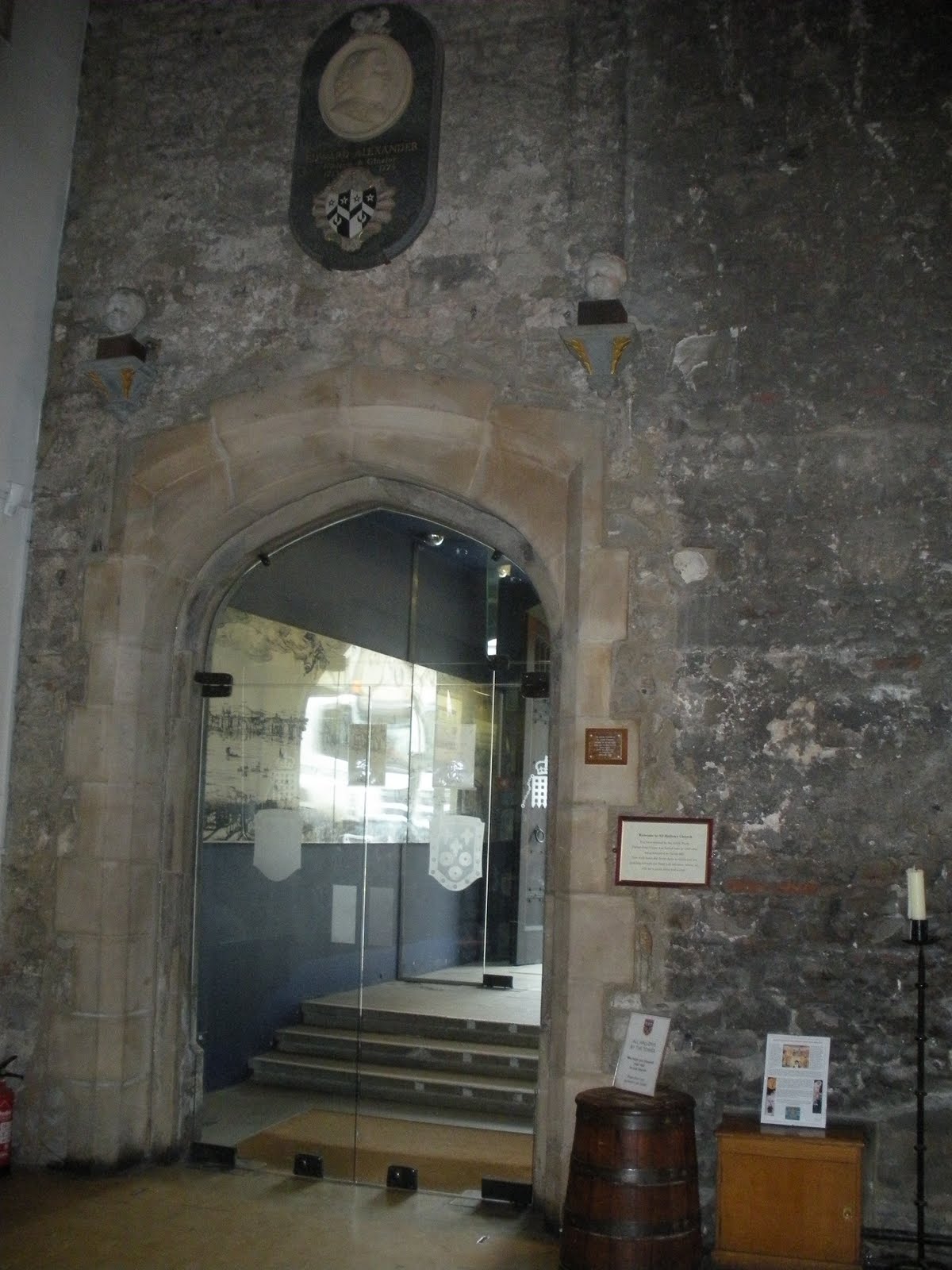
The oldest church in the City of London, All Hallows name partly derives from its proximity to the Tower of London. Fortunately it is one of the only churches in the city that survived the ghastly fire of 1666 primarily because it was so close to the Tower (which was full to the brim of ammunition which meant the authorities did everything they could to keep the fire away). Mary had no direct connection with the place but it is believed that one of the most ardent defenders of her parents’ marriage, John Fisher, bishop of Rochester (St John Fisher), was buried there following his execution in 1535. The chapel of St Peter ad Vincula within the Tower is well known as the burial ground of condemned traitors but All Hallows served as an alternative resting place. Who else connected to Mary was buried here remains a mystery; perhaps various individuals she sent to their deaths? The church is also worth visiting for its connections to William Penn (who was baptised here), and John Quincy Adams who married here in 1797. The church is free to enter and photography is permitted.


Alleged site of Bishop Fisher's resting place.


5. Old Chelsea Church, London

Chelsea Manor, a grand house owned by various prominent individuals including Sir Thomas More, is long gone though the church remains. Most of the church was destroyed by bombing in WWII yet the More chapel remained. Jane Dudley, duchess of Northumberland who, ironically, Mary was close to and was godmother to at least one of her children, is buried here. It was at Chelsea Manor that Jane Grey was told of Edward VI’s death; Anne of Cleves, Mary’s stepmother, died here in July 1557. The property was also owned by Katherine Parr who settled here after Henry VIII’s death with her stepdaughter and Mary’s sister, Elizabeth, in her care. The church is free to enter and photography is permitted.


Image of Jane Dudley, duchess of Northumberland on her tomb


6. Whitehall

Virtually nothing remains of the impressive palace Henry constructed. It was the grandest palace he owned and special lodgings for Mary were constructed there in the 1540s. Henry died here in January 1547 and in 1554 it was the scene of Cardinal Reginald Pole’s public reception by Mary and her husband Philip; Pole’s arrival signified the official proceedings that reunited England with the Catholic Church. ‘Henry VIII’s wine cellar’, the last remnant of his palace, is located in the basement of the Ministry of Defence.


7. Guildhall

A definite must see. It was here, in 1554, that Mary rallied the citizens of London against the rebels of Wyatt’s uprising that attempted to take the city. Jane Grey was condemned to death here in 1554 along with her husband Guilford Dudley, his brothers Henry and Ambrose, and the archbishop of Canterbury, Thomas Cranmer (though Cranmer would later be tried for heresy and sentenced to death on these charges). The present Guildhall was built between 1411 and 1430 though was affected by both the fire of 1666 and bombing in WWII. One single window survived the blast – when entering the hall it is on the immediate right. There is a plaque in the hall commemorating notable trials that took place, listing several that occurred during Mary’s reign. Make sure to go into the crypts to check out the medieval foundations and a nineteenth-century stained glass window depicting Sir Thomas More.


Guildhall


8. Westminster Hall

The oldest part of the Palace of Westminster, the hall was built in 1097 intending to be a place for banquets. The hall later served several functions, including becoming the scene of many famous trials. In 1553 Mary’s opponent, John Dudley, duke of Northumberland, was tried for treason here and a year later the duke of Suffolk, father to Lady Jane Grey, was condemned to death for his involvement in Wyatt’s rebellion. On 1st October, Mary proceeded into the hall in full regalia shortly after her coronation ceremony. She subsequently presided over her magnificent coronation banquet which lasted for some hours. It goes without saying that security is tight and queues long. Photography is permitted in only the hall.


Westminster Hall


9. The Tower of London

The Tower of London is one of those places which everyone has to visit at least once. Well maybe twice. Or three times; or even four, and maybe.... well, lets just say that despite the absurdly high entrance fee it must be seen. Mary’s allies and enemies spent time in this gloomy fortress and she resided her briefly before her coronation as was the custom. Most of these condemned individuals were executed outside on Tower Hill (right by the tube station of the same name), though of the few executed within, on Tower Green, Mary could claim connections. Two of her stepmothers lost their lives here (Anne Boleyn and Katherine Howard) as well as her long-term governess, supporter and relation, Margaret Pole, Countess of Salisbury. It was also the site of an execution carried out on her orders – the beheading of Lady Jane Grey. Elizabeth, Mary’s sister, would famously spend time here, after she was accused of complicity in Wyatt’s rebellion. As mentioned, entrances prices are high and if you are thinking of visiting on a frequent basis I recommend applying for membership. For £41 a year you can visit the Tower (and Hampton Court Palace) to your heart’s content.


The Chapel of St Peter ad Vincula


10. Southwark Cathedral and Winchester Palace

During Mary’s reign, trials for heresy were held in the Retro-Choir, the oldest part of the cathedral. The trials were overseen by Stephen Gardiner bishop of Winchester, for the cathedral was then under his authority. The first individual burnt for heresy during Mary’s reign – John Rogers – was condemned here, as was Bishop John Hooper who was sent back to his diocese of Gloucester to die. There is no entrance fee but if you wish to take photos there is a very small charge.

Though only a few ruins remain, Winchester Palace is still a place to visit. It located less than 10 minutes from Southwark Cathedral so it is best to see both during one trip. It was the seat of Stephen Gardiner, who was also Lord Chancellor under Mary. According to one contemporary, Gardiner entertained Henry VIII and Katherine Howard at this residence during Henry’s attempts to annul his marriage to Anne of Cleves, facilitating his union with Katherine (Mary’s fourth stepmother).


Southwark Cathedral


11. Smithfield

Today known for the meat market, Smithfield was once a notorious place of execution. In Mary’s day it was a cattle and horse market, which also served as a venue for public burnings of heretics. During Mary’s reign, seven Protestants were sent to their deaths here including John Rogers, John Cardmaker, John Bradford, John Philpot, Thomas Tompkins, John Warne and John Leafe. Rogers was the first Protestant to die on charges of heresy during Mary’s reign and his courageous example was regarded as inspirational by supporters. Offered a pardon at the execution, Rogers refused, told the crowd to be unwavering in their faith, was tied to the stake and the fire lit. Whilst the flames consumed his body he ‘washed his hands in the flame’ (Foxe, Acts and Monuments) until it covered his whole body; a symbolic act of washing away the sins. A plaque commemorating the Marian martyrs can be found on the site. When in the area be sure to go into the Priory Church of St Bartholomew the Great which contains one of only two pre-Reformation fonts in London. From 1539 the Lady Chapel served as a printing house. Benjamin Franklin once worked here (when it was Samuel Palmer's printing shop). Fans of films set in the Tudor period may find the place familiar; scenes from Shakespeare in Love and The Other Boleyn Girl were filmed here. There is a small entrance fee and photography is permitted.


Plaque for the Smithfield martyrs


12. Museum of London

A museum which, as the name suggests, charts the history of the city. The galleries of interest to Tudor enthusiasts were recently renovated. There isn’t much on Mary aside from a very small section on the London Protestant Martyrs and the Reformation, but it is still worth seeing. They also house artefacts from the long gone Nonsuch palace, which was built by Henry VIII in the 1530s. Evidently Mary knew the palace well. The museum is free to enter.


13. The Victoria and Albert Museum

The V&A does hold objects relating to the Tudors but not a vast collection. However its new renaissance wing, which provides context on the age Mary lived through, is outstanding. There are some interesting objects connected to her relatives, including a stained glass window of her aunt and her husband’s grandmother, Juana of Castile. In the British gallery there are different objects connected to the Tudors, including Henry VIII’s writing desk. Entrance is free.


Stained glass window depicting Juana of Castile commissioned for the Chapel of the Holy Blood in Bruges, c.1496


14. Westminster Abbey

No tour of places connected to Mary is complete without a visit to her resting place. Mary requested burial in the abbey and intended to have her mother’s body brought here where the two would share a grand tomb. In the end Mary did end up sharing a tomb with a female relative but not one she would have been happy to be situated next to. The grand monument to Elizabeth marks the spot of Mary’s burial. A plaque in front of the tomb reads, ‘Partners both in throne and grave, here rests we two sisters, Mary and Elizabeth, in the hope of one resurrection’. Aside from Mary and Elizabeth, two other Tudor monarchs can be found in the abbey, Henry VII and Edward VI, along with Mary’s grandmother, Elizabeth of York and her stepmother, Anne of Cleves. Cousin Frances Grey, duchess of Suffolk (Jane Grey’s mother) was also buried here as was Margaret Douglas, Countess of Lennox who Mary was rumoured to favour as her successor. Be sure to check out the abbey’s museum (entrance fee included with the ticket for the abbey) that houses Mary’s funeral effigy. It goes without saying that the ticket price is absurdly high but like the Tower it just is one of those places you have to go to. Get there early to avoid the queues!


The head of Mary's funeral effigy


Enjoy the Mary tour!


(Though I’ve stated that some places allow photography, always ask beforehand. I have not included Hampton Court Palace as that was not part of London then nor is it now, though it is located a short train ride away and is lovely to look around in summer. Eltham Palace, the childhood home of Henry VIII, is also worth a trip. Take the DLR all the way to Lewisham and from there board a train to Eltham which is about 10 minutes away).