1. Greenwich
As the place of Mary’s birth, Greenwich fully deserves it places on this list of Mary related London sites. The palace where she was born (also the birthplace of Henry VIII and Elizabeth I) and the adjoining Church of the Observant Friars where she was christened are long gone. But Greenwich is still a great tourist hotspot. The Discover Greenwich centre has recently opened and various sixteenth-century artefacts are on display (though the focus is very much on Henrician and Elizabethan Greenwich). The park, where Henry VIII often went hunting, was a familiar site to Mary. Be sure to check out St Alfege Church which is about 5 minutes from Cutty Sark tube station. Though much amended since Mary’s day it is the burial place of the great sixteenth-century composer, Thomas Tallis, who served in the Chapel Royal under Henry VIII, Edward VI, Mary and Elizabeth. The church also holds the ‘Tallis keyboard’ which contains several sixteenth-century keys that were allegedly played by Tallis and the princesses Mary and Elizabeth.

The 'Tallis Keyboard'
2. St Margaret’s Church, Westminster
Located right by the abbey, this church admittedly has little in connection to Mary. But it is worth going in to see the stained glass window depicting a young Henry VIII and Katherine of Aragon. The window was commissioned by Henry VIII in the 1520s and was given as a gift to Waltham abbey, but shortly after the break from Rome it was confiscated by the King and placed in the chapel at Beaulieu. Beaulieu, otherwise known as New Hall, was one of the properties Mary inherited from her father and was one of her favourite residences. So the window was once her property and something she would have known well. It was relocated to St Margaret’s in the eighteenth-century. Entrance is free but photography is not allowed.
.JPG)
Detail of Katherine of Aragon in the stained glass window in St Margaret's
3. The National Portrait Gallery
Though small, the Tudor galleries in the NPG are a delight. See the c.1544 portrait of Mary – the first portrait she commissioned of herself, to mark her re-inclusion in the succession. There is also a miniature of Mary by Lucas Horenbout which depicts her wearing a brooch with her then betrothed’s name on it (Emperor Charles V). Room one is a collection of portraits of Mary’s family – a posthumous portrait of her mother can be found here, along with a fabulous painting of Katherine Parr that was misidentified as Lady Jane Grey for many years. But no Tudor gallery would be complete without a portrait of Henry VIII and by Holbein no less. Holbein’s preparatory drawing of the King for the Whitehall Mural is one of the first items you see when you enter the room. Ironically the portrait of Mary is almost directly opposite one of her victims – Thomas Cranmer, archbishop of Canterbury. Entrance is free. Make sure to go next door into The National Gallery (also free) and see the Holbein portrait of Christina of Denmark, Mary’s cousin once removed and at one point a possible stepmother when Henry attempted to negotiate a marriage with the widowed Christina in the late 1530s. Luckily Christina eluded him.
4. All Hallows by the Tower
The oldest church in the City of London, All Hallows name partly derives from its proximity to the Tower of London. Fortunately it is one of the only churches in the city that survived the ghastly fire of 1666 primarily because it was so close to the Tower (which was full to the brim of ammunition which meant the authorities did everything they could to keep the fire away). Mary had no direct connection with the place but it is believed that one of the most ardent defenders of her parents’ marriage, John Fisher, bishop of Rochester (St John Fisher), was buried there following his execution in 1535. The chapel of St Peter ad Vincula within the Tower is well known as the burial ground of condemned traitors but All Hallows served as an alternative resting place. Who else connected to Mary was buried here remains a mystery; perhaps various individuals she sent to their deaths? The church is also worth visiting for its connections to William Penn (who was baptised here), and John Quincy Adams who married here in 1797. The church is free to enter and photography is permitted.
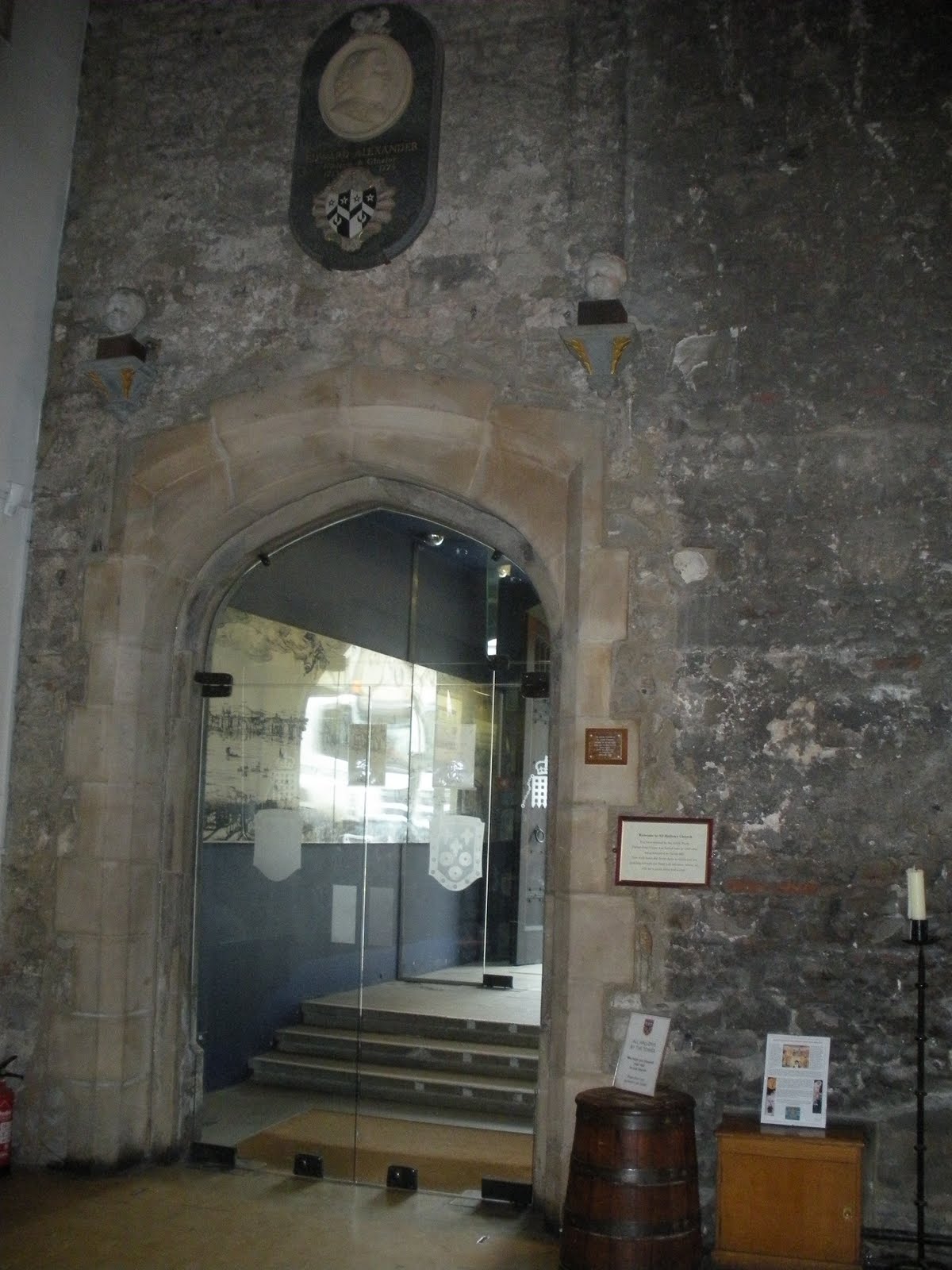
Alleged site of Bishop Fisher's resting place.
5. Old Chelsea Church, London
Chelsea Manor, a grand house owned by various prominent individuals including Sir Thomas More, is long gone though the church remains. Most of the church was destroyed by bombing in WWII yet the More chapel remained. Jane Dudley, duchess of Northumberland who, ironically, Mary was close to and was godmother to at least one of her children, is buried here. It was at Chelsea Manor that Jane Grey was told of Edward VI’s death; Anne of Cleves, Mary’s stepmother, died here in July 1557. The property was also owned by Katherine Parr who settled here after Henry VIII’s death with her stepdaughter and Mary’s sister, Elizabeth, in her care. The church is free to enter and photography is permitted.

Image of Jane Dudley, duchess of Northumberland on her tomb
6. Whitehall
Virtually nothing remains of the impressive palace Henry constructed. It was the grandest palace he owned and special lodgings for Mary were constructed there in the 1540s. Henry died here in January 1547 and in 1554 it was the scene of Cardinal Reginald Pole’s public reception by Mary and her husband Philip; Pole’s arrival signified the official proceedings that reunited England with the Catholic Church. ‘Henry VIII’s wine cellar’, the last remnant of his palace, is located in the basement of the Ministry of Defence.
7. Guildhall
A definite must see. It was here, in 1554, that Mary rallied the citizens of London against the rebels of Wyatt’s uprising that attempted to take the city. Jane Grey was condemned to death here in 1554 along with her husband Guilford Dudley, his brothers Henry and Ambrose, and the archbishop of Canterbury, Thomas Cranmer (though Cranmer would later be tried for heresy and sentenced to death on these charges). The present Guildhall was built between 1411 and 1430 though was affected by both the fire of 1666 and bombing in WWII. One single window survived the blast – when entering the hall it is on the immediate right. There is a plaque in the hall commemorating notable trials that took place, listing several that occurred during Mary’s reign. Make sure to go into the crypts to check out the medieval foundations and a nineteenth-century stained glass window depicting Sir Thomas More.

Guildhall
8. Westminster Hall
The oldest part of the Palace of Westminster, the hall was built in 1097 intending to be a place for banquets. The hall later served several functions, including becoming the scene of many famous trials. In 1553 Mary’s opponent, John Dudley, duke of Northumberland, was tried for treason here and a year later the duke of Suffolk, father to Lady Jane Grey, was condemned to death for his involvement in Wyatt’s rebellion. On 1st October, Mary proceeded into the hall in full regalia shortly after her coronation ceremony. She subsequently presided over her magnificent coronation banquet which lasted for some hours. It goes without saying that security is tight and queues long. Photography is permitted in only the hall.

Westminster Hall
9. The Tower of London
The Tower of London is one of those places which everyone has to visit at least once. Well maybe twice. Or three times; or even four, and maybe.... well, lets just say that despite the absurdly high entrance fee it must be seen. Mary’s allies and enemies spent time in this gloomy fortress and she resided her briefly before her coronation as was the custom. Most of these condemned individuals were executed outside on Tower Hill (right by the tube station of the same name), though of the few executed within, on Tower Green, Mary could claim connections. Two of her stepmothers lost their lives here (Anne Boleyn and Katherine Howard) as well as her long-term governess, supporter and relation, Margaret Pole, Countess of Salisbury. It was also the site of an execution carried out on her orders – the beheading of Lady Jane Grey. Elizabeth, Mary’s sister, would famously spend time here, after she was accused of complicity in Wyatt’s rebellion. As mentioned, entrances prices are high and if you are thinking of visiting on a frequent basis I recommend applying for membership. For £41 a year you can visit the Tower (and Hampton Court Palace) to your heart’s content.

The Chapel of St Peter ad Vincula
10. Southwark Cathedral and Winchester Palace
During Mary’s reign, trials for heresy were held in the Retro-Choir, the oldest part of the cathedral. The trials were overseen by Stephen Gardiner bishop of Winchester, for the cathedral was then under his authority. The first individual burnt for heresy during Mary’s reign – John Rogers – was condemned here, as was Bishop John Hooper who was sent back to his diocese of Gloucester to die. There is no entrance fee but if you wish to take photos there is a very small charge.
Though only a few ruins remain, Winchester Palace is still a place to visit. It located less than 10 minutes from Southwark Cathedral so it is best to see both during one trip. It was the seat of Stephen Gardiner, who was also Lord Chancellor under Mary. According to one contemporary, Gardiner entertained Henry VIII and Katherine Howard at this residence during Henry’s attempts to annul his marriage to Anne of Cleves, facilitating his union with Katherine (Mary’s fourth stepmother).

Southwark Cathedral
11. Smithfield
Today known for the meat market, Smithfield was once a notorious place of execution. In Mary’s day it was a cattle and horse market, which also served as a venue for public burnings of heretics. During Mary’s reign, seven Protestants were sent to their deaths here including John Rogers, John Cardmaker, John Bradford, John Philpot, Thomas Tompkins, John Warne and John Leafe. Rogers was the first Protestant to die on charges of heresy during Mary’s reign and his courageous example was regarded as inspirational by supporters. Offered a pardon at the execution, Rogers refused, told the crowd to be unwavering in their faith, was tied to the stake and the fire lit. Whilst the flames consumed his body he ‘washed his hands in the flame’ (Foxe, Acts and Monuments) until it covered his whole body; a symbolic act of washing away the sins. A plaque commemorating the Marian martyrs can be found on the site. When in the area be sure to go into the Priory Church of St Bartholomew the Great which contains one of only two pre-Reformation fonts in London. From 1539 the Lady Chapel served as a printing house. Benjamin Franklin once worked here (when it was Samuel Palmer's printing shop). Fans of films set in the Tudor period may find the place familiar; scenes from Shakespeare in Love and The Other Boleyn Girl were filmed here. There is a small entrance fee and photography is permitted.

Plaque for the Smithfield martyrs
12. Museum of London
A museum which, as the name suggests, charts the history of the city. The galleries of interest to Tudor enthusiasts were recently renovated. There isn’t much on Mary aside from a very small section on the London Protestant Martyrs and the Reformation, but it is still worth seeing. They also house artefacts from the long gone Nonsuch palace, which was built by Henry VIII in the 1530s. Evidently Mary knew the palace well. The museum is free to enter.
13. The Victoria and Albert Museum
The V&A does hold objects relating to the Tudors but not a vast collection. However its new renaissance wing, which provides context on the age Mary lived through, is outstanding. There are some interesting objects connected to her relatives, including a stained glass window of her aunt and her husband’s grandmother, Juana of Castile. In the British gallery there are different objects connected to the Tudors, including Henry VIII’s writing desk. Entrance is free.

Stained glass window depicting Juana of Castile commissioned for the Chapel of the Holy Blood in Bruges, c.1496
14. Westminster Abbey
No tour of places connected to Mary is complete without a visit to her resting place. Mary requested burial in the abbey and intended to have her mother’s body brought here where the two would share a grand tomb. In the end Mary did end up sharing a tomb with a female relative but not one she would have been happy to be situated next to. The grand monument to Elizabeth marks the spot of Mary’s burial. A plaque in front of the tomb reads, ‘Partners both in throne and grave, here rests we two sisters, Mary and Elizabeth, in the hope of one resurrection’. Aside from Mary and Elizabeth, two other Tudor monarchs can be found in the abbey, Henry VII and Edward VI, along with Mary’s grandmother, Elizabeth of York and her stepmother, Anne of Cleves. Cousin Frances Grey, duchess of Suffolk (Jane Grey’s mother) was also buried here as was Margaret Douglas, Countess of Lennox who Mary was rumoured to favour as her successor. Be sure to check out the abbey’s museum (entrance fee included with the ticket for the abbey) that houses Mary’s funeral effigy. It goes without saying that the ticket price is absurdly high but like the Tower it just is one of those places you have to go to. Get there early to avoid the queues!

The head of Mary's funeral effigy
Enjoy the Mary tour!
(Though I’ve stated that some places allow photography, always ask beforehand. I have not included Hampton Court Palace as that was not part of London then nor is it now, though it is located a short train ride away and is lovely to look around in summer. Eltham Palace, the childhood home of Henry VIII, is also worth a trip. Take the DLR all the way to Lewisham and from there board a train to Eltham which is about 10 minutes away).


