Showing posts with label Philip of Spain. Show all posts

Thursday, 22 December 2011

Review of Harry Kelsey's Philip of Spain, King of England: The Forgotten Sovereign (2011)

Harry Kelsey, Philip of Spain, King of England: The Forgotten Sovereign (London and New York: I.B. Tauris, 2011), 288pp. £18.99.


There have been several calls for a study of Philip of Spain’s time as King of England over recent years. This is hardly surprising. Present-day scholarship of Mary’s reign is continuously growing, drawing attention to remaining overlooked areas. Interest in queenship, especially during the Tudor period, has increased. Yet examinations of Mary’s status as England’s first crowned queen regnant can only progress so far without a comprehensive study of her consort. Research into the Marian Church is also somewhat affected by the lack of work on Philip. We have come to recognise the influence some within Philip’s retinue exerted. The decision to return to Rome under Mary was certainly not the policy of these men alone, nor were they chiefly responsible for the measures implemented by the queen and her government, but the case of Friar Bartolomé Carranza alone indicates the significant role some played.1 An oversight of a more important figure – Mary’s own husband – is nonsensical. Finally, Philip was England’s first king-consort. Matilda in the twelfth-century and Jane Grey/Dudley in 1553 both were married at the time they made a bid for the throne but neither were crowned and Jane, acknowledged as queen at one point, never conferred upon her husband the title of ‘king’. Philip, on the other hand, married Mary around year after she became queen, was acknowledged as her lawful husband and thus king by all. Yet he was also refused a coronation, faced numerous limitations on his powers and had a complex relationship with his new subjects the English that continued long after Mary’s death. This is interesting stuff and should be examined in its own right.


So Philip Kelsey’s study, Philip of Spain, King of England: The Forgotten Sovereign, should be a welcomed addition to the numerous works already published on Mary’s reign. Anna Whitelock’s review on the dust-jacket promises the book to be ‘a timely attempt to place him [Philip] centre stage’. Sadly I was unable to agree.


This is not an in-depth study of Philip’s role as King of England. The book is 162 pages long (of main text) and though book-lengths aren’t everything this is clearly a rather fast-paced observation. Often the basics are covered with little attempt to divulge further. An example of this can be found in Kelsey’s account of Mary and Philip’s wedding. It amounts to just four pages and is concerned chiefly with providing a literal description, from who said what to who stood where. Kelsey does not elaborate upon the fact that contemporary accounts state Mary was placed on the right and Philip on the left during the service – a reversal of the typical positions for bride and groom – and that Mary sat on a larger throne. As Alexander Samson put it, ‘the positioning of Philip and Mary in the church was designed to underline Mary’s continuous precedence over Philip as English sovereign, even in the context of her marriage to him, by placing her in the space traditionally reserved for a king and Philip in that of a queen consort’.2 Nonetheless there were similarities in their dress leading to the theory that ‘a kind of equality between them in terms of power’ was being suggesting here.3 None of this is discussed by Kelsey. He does mention in a footnote that ‘the various descriptions of the ceremony differ considerably. I have relied largely on Figueroa, who wrote his report the next day, while events were fresh in his mind’ (fn 12, p. 188). But he does not discuss why such contradictions existed; why English chroniclers suggesting one thing, and Spanish observers claimed another.


Kelsey’s rather constrained examination of issues regarding female rule at that time is evident throughout this book. Of Mary’s speech at the Guildhall, London in 1554, he provides the rudiments, namely Mary’s arguments that prospective husband Philip would be able to defend England against its foreign enemies (pp. 68-9). What he does not mention is arguably the most famous aspect of the speech – when Mary referred to herself as ‘wedded to the realm’, with her coronation ring being her ‘spousal ring’ signifying the enduring bond between herself and the people. Mary’s own perceptions about her upcoming marriage and the impact it would have upon her powers and relationship with her subjects is overlooked. References to studies on queenship are thin on the ground. The only two of significance used are Glyn Redworth, ‘‘Matters Impertinent to Women’: Male and Female Monarchy under Philip and Mary’, English Historical Review, 112, 447 (1997), pp. 597-613 and Judith Richards, ‘Mary Tudor as ‘Sole Queen’? Gendering Tudor Monarchy’, Historical Journal, 40 (1997), pp. 895-924.


This leads to a major issue of the book. When exactly was it written? It was published only last month (November 2011), though reads as if it was completed around five or so years ago. The bibliography only confirms this. The most up-to-date studies I could find there were Eamon Duffy and David Loades (eds.), The Church of Mary Tudor (Aldershot: Ashgate, 2006) and Elizabeth Svoboda, ‘All the Signs of Pregnancy Except One: A Baby’, New York Times, 5 December 2006 (an article concerning pseudocyesis – ‘phantom pregnancy’ – a condition that Mary may have experienced twice). If this was completed around, let’s say 2006-8, then Kelsey may be forgiven for his overlooking recent works. I acknowledge that the gap in writing to publication may be out of Kelsey’s hands but surely concerns were raised about the status of the book in the wake of a spate of works into Mary and her reign? And, if we accept it was written just past the mid-2000s this still doesn’t explain why Kelsey ignored several studies, some dating to the 1990s, that are of vital importance to any historian writing on Philip as King of England. I am thinking mainly here of the research of Alexander Samson. Samson’s PhD thesis, ‘The Marriage of Philip of Habsburg and Mary Tudor and Anti-Spanish Sentiment in England’ (University of London, 1999) is undoubtedly useful, especially Samson’s diligent consultation of both Spanish and English sources. If Kelsey had issues in obtaining the thesis, this does not excuse the oversight of Samson’s article, ‘Changing Places: the Marriage and Royal Entry of Philip, Prince of Austria, and Mary Tudor, July-August 1554’, The Sixteenth Century Journal, 36, 3 (2005), pp. 761-84. There was also no reference to David Loades’s work on ‘Philip II as King of England’, nor to a collection of articles on Friar Bartolomé Carranza’s role in the Marian Church which provides evidence of Spanish influence in the English church naturally initiated by Philip’s marriage to Mary.4 Why ignore research with obvious relevance to your own study?


There were some other issues I had with particular details in the book. Apologises if this all sounds too pedantic...


Kelsey implies Mary was unused to government. After all, she had never been raised to be monarch; Henry VIII’s desire to produce a son and secure a male succession is well known. But Kelsey goes too far in asserting that Mary ‘was never allowed to participate in government or to learn the intricacies of court politics’ (p. 27). Mary may have not been granted political office during her father’s lifetime, but at a young age had been created as the de facto princess of Wales and made head of a vice-regal household sent to the Welsh Marches. Yes, Mary was young and not expected to govern independently, but the Crown was still to be represented through her person and Mary was to engage in a ceremonial and symbolic role. Ultimately it was a role, however confined that may be and, ironically, it was a greater experience in matters of government than her siblings received during their father’s lifetime. I also find it incredibly hard to assert that Mary was unused to the intricacies, and intrigues, of the court. An argument for Mary striving to keep in her father’s good graces unattached to any particular faction at court can be made for 1536 onwards, but the idea she was completely unused to the whole concept of court politics (which was in essence court life) makes little sense. Mary maintained a complex network of affiliates, with court reformers and conservatives alike, and was able to call upon the assistance of many of these individuals during her bid for the throne in July 1553. But simple, she was a witness and member of the Henrician court. She may have been barred from it during her years of disgrace (c.1533-6), but the 1540s was a different story. Kelsey even contradicts himself on this point. He later writes that ‘some historians now argue that Mary deliberately created much of her reputation as an ineffective ruler in order to achieve the goals she wanted, as well as to deflect attention from herself and blame others for the more intractable problems that plagued her government’ (p. 124). Admittedly I do not think this interesting argument is a credible one, but whether we wish to believe it or not it must be acknowledged that this strategy is highly calculating and impractical to carry though by someone unfamiliar to participation in government and ‘the intricacies of court politics’. Kelsey toys with the idea that Mary was astute and manipulative and in doing so makes her appear a far more impressive political player than he implies her education allowed her to be.


Kelsey notes that Henry VIII made the infant princess Elizabeth ‘Princess of Wales, reducing Mary to the status of lady-in-waiting’ (p. 29). Mary never occupied such a role; the imperial ambassador Eustace Chapuys gave raise to fears she would be made to be some servant to Elizabeth but this irrational accusation turned out to be false. Additionally Elizabeth was never officially created princess of Wales. Kelsey dates the third Act of Succession (that re-included Mary and Elizabeth into the line of succession) to 1543 when it was ratified in 1544 (p. 33). Philip’s fourth wife is named as his ‘cousin’ Anne of Austria, though she was his niece (p. 139). Kelsey mentions that Bishop Stephen Gardiner wanted Mary to marry an English candidate, including Cardinal Reginald Pole but this was not possible for by her accession Pole had received Holy Orders (p. 53). This seems highly unlikely. Gardiner’s support for Pole as archbishop of Canterbury at this time was begrudgingly given at best. Gardiner clearly favoured Edward Courtenay, earl of Devon as Mary’s prospective husband, not Pole. As one of Gardiner’s biographers put it, Gardiner was ultimately prepared to see Pole as the next archbishop for this ‘would have the added advantage of ensuring that he could not rival Courtenay as the indigenous candidate for Mary’s hand’.5 On the issue of Philip’s status upon his marriage to Mary, Kelsey notes that Charles V gave his son the kingdom of Naples and dukedom of Milan as wedding gifts (p. 77). Yet in a separate footnote, Kelsey mentions that around the same time Philip asked a herald not to mention his status as duke of Milan for he had been given it back in the early 1540s so it was ‘old stuff’ (fn 15, p. 189). He also mentions earlier on that Charles had named Philip the duke back in 1546 (p. 27). An explanation of the rather complicated history surrounding Philip’s investiture as duke of Milan is not provided for the reader. Philip had been invested with the title in 1541 and 1546 though Charles had not relinquished control over the duchy. It was transferred again to Philip in 1554 at the time of his marriage, though it was a title he regarded as having been his for some years.6 Finally, Kelsey mentions the possibility that Elizabeth I ‘suffered from Androgen Insensitivity Syndrome’, a condition whereby ‘a male child has the external features of a female but with shallow vagina and undeveloped ovaries’. Evidence for this, we are told, ‘is contradictory’ (p. 156). ‘Contradictory’ is too diplomatic a term; I would just go with ‘absurd’.


So far I have dwelled on the negatives, and in truth I believe they overwhelm the qualities of the book. However I take to heart the advice that if you do not have anything nice to say (or write) then say nothing at all! This isn’t all bad. Kelsey’s writing style is good; the reader is not faced with numerous grammatical mistakes or my pet hate – a string of very short paragraphs. Though I have issues with what he references, he does reference frequently so there is no chasing around for sources. There is a good selection of manuscripts used though often Kelsey cites from nineteenth-century transcripts like the State Papers, Foreign and Domestic, etc series. Kelsey gives due consideration to Philip’s personality and upbringing, and his romantic escapades. He cannot be accused of being either blind to Philip’s faults or neglectful of his qualities as many previous historians have been. I was especially interested in Kelsey’s observation of previous treaties between England and Spain, namely the 1542 one which promised aid to in times of conflict. Kelsey shows how this was raised during Mary and Philip’s marriage when the Spanish sought assistance in their war with the French. It is often implied that England entered war with France, and subsequently lost Calais, through the Spanish marriage alone, but the precedent for assistance between the Habsburgs and Tudors is emphasised here (pp. 118 and 129). The book does include illustrations though they are not of exceptional quality and are predominantly much later (including nineteenth-century) images. The maps are useful, but Kelsey fails to incorporate the illustrations into the text. They standalone which some may find absolutely fine, but I think if pictures are included there should be some purpose to them and not used in a decorative-like manner.


In 1570, some 12 years after Mary’s death, Philip claimed that he could give Pope Pius V ‘better information and advice on that kingdom [England], and on its affairs and people, than anyone else’.7 Clearly Philip believed he had not come away from the whole experience empty handed. His relationship with the English was at best complex but he took his role as King of England seriously and, as the quote suggests, believed himself to be an authority on that realm. This book has not proved to be a definitive or substantial account of Philip’s time as King of England. It covers briefly his involvement in the Marian Church and his influence over the direction of foreign policy, but there is no discussion of his improvements of the English navy (which of course backed fired on him in the end!), nor on his interest in another part of Mary’s realm – Ireland. It also suffers from a lack of discussion of recent works. As a result it seems distinct from current scholarship, in sharp contrast with John Edwards’ excellent Mary I: England’s Catholic Queen (New Haven and London: Yale University Press, 2011), which paid due consideration to Philip’s role, used an array of Spanish sources and up-to-date studies. As a result I would recommend Edwards’ biography of Mary over this book when it comes to the issue of Philip’s time as king-consort. More needs to be done though on the Habsburg who became England’s king. Popular knowledge of Philip’s later and troublesome relationship with the English and former sister-in-law Elizabeth I is well known. It is time to shed more light on the origins of that relationship, which was not as fruitless as the events of the 1580s would have us believe.


1 John Edwards and Ronald Truman (eds.), Reforming Catholicism in the England of Mary Tudor: The Achievments of Friar Bartolomé Carranza (Aldershot: Ashgate, 2005).
2 Alexander Samson, ‘Changing Places: The Marriage and Royal Entry of Philip, Prince of Austria, and Mary Tudor, July-August 1554’, The Sixteenth Century Journal, 36, 3 (2005), p. 763.
3 Ibid, p. 765.
4 David Loades, ‘Philip II as King of England’, in C. Cross, D. M. Loades and J. J. Scarisbrick (eds.), Law and Government under the Tudors: Essays Presented to Geoffrey Elton (Cambridge: Cambridge University Press, 1988), pp. 177-94. For the articles on Carranza see fn 1. Kelsey also ignores John Edwards’ work on Spanish influence in Marian England including Edwards, ‘A Spanish Inquisition? The repression of Protestantism under Mary Tudor’, Reformation and Renaissance Review, iv (2000), pp. 62-74.
5 Glyn Redworth, In Defence of the Church Catholic: The life of Stephen Gardiner (Oxford: Basil Blackwell, 1990), pp. 306-7. We also have to consider that Pole had no intention to marry Mary in 1553 nor was she interested in him.
6 M. J. Rodríguez-Salgado, The Changing Face of Empire: Charles V, Philip II and Habsburg Authority, 1551-1559 (Cambridge: Cambridge University Press, 1988), pp.103-6.
7 Philip II to Don Guerau de Spes, 30 June 1570, cited from Geoffrey Parker, ‘The Place of Tudor England in the Messianic Vision of Philip II of Spain’, Transactions of the Royal Historical Society, 12 (2002), p. 185.


And on a completely unrelated note - Merry Christmas and Happy New Year to you all!

Wednesday, 7 September 2011

Review of John Edwards, Mary I: England’s Catholic Queen (2011)

Last week’s holiday provided me with the perfect chance to read the latest biography of Mary. Perhaps not ideal beside-the-pool reading, but I wasn’t disappointed...


John Edwards, Mary I: England’s Catholic Queen (New Haven and London: Yale University Press, 2011), 387pp. £25.


Works on Mary I and her reign do not reach the number of studies on her father and half-sister. Still, she is the subject of a fair number of biographies. Compare this to biographies of Henry VIII; Scarisbrick’s Henry VIII, first published in 1968, still remains the leading account of this monarch’s life. Mary, on the other hand, has at least five biographies to her name published since 2006 (not counting reprints), all of which are readily available in mainstream book shops. This includes the latest offering, by John Edwards, which has already been heralded as ‘the first time we have a proper account of her with a fully European-wide perspective’ (Professor Diarmaid MacCulloch) and ‘the best scholarly biography of Mary I’ (Professor Ethan Shagan). And such comments are not far off the mark.


John Edwards’ book forms part of the Yale English Monarchs Series which already includes separate biographies of the Tudor kings. The works, or at least the ones I have read, act as introductory texts yet are also incredibly valuable to those rather clued up on the various figures. Having read nearly all the biographies of Mary published in modern times, it is easy to get – dare I say this? – slightly bored of reading lengthy discussions on Mary’s parental and maternal ancestry at the beginning of each biography along with a very detailed account of Katherine of Aragon’s time in England before her daughter’s birth, her marriage to Prince Arthur, then to Henry VIII, the accompanying treaties, etc. Edwards is particularly skilled in providing the reader with the necessary details, naturally of great benefit to those new to Tudor history, whilst not diverting from his subject. It is a very subtle way of dealing with the always essential but sometimes burdensome context.


It’s best to start with the positives of this book and there are many. Undoubtedly this biography is the most important one of Mary in regards to her marriage, her husband’s role as King of England, and Anglo-Spanish relations in general throughout the course of Mary’s lifetime. Edwards is a Modern Languages Faculty Research Fellow in Spanish at Oxford University and specialises in Early Modern Spain. He has already written a joint biography on Mary’s maternal grandparents, Ferdinand and Isabella, along with a separate one on Isabella. He is an authority on the Spanish Inquisition and Spanish religious influence in mid-Tudor England. His knowledge of Spanish sources of this period shines through this book. Not only has he exhausted Spanish archives for primary sources (some of which are not used in other works on Mary) but he is mindful of secondary Spanish sources. I was impressed (and jealous) that he got hold of María Jesús Pérez Martín’s María Tudor: La gran reina desconocida (Madrid: Ediciones Rialp, 2008) which clearly helped guide him to certain primarily materials in Spain. The result of such wide-ranging research, unconfined to the libraries and archives in the UK, is a marvellous account of Mary’s relationship with her Habsburg relations. Or, as Diarmaid MacCulloch nicely put it, Mary as ‘a Trastamara princess as well as a Tudor’.


There is ample information on Mary’s marriage to Philip of Spain, namely the complicated route to the union, Philip’s attitudes to becoming King of England, and of the grand plans Philip’s father Charles V had for his dynasty. The personalities of these Spanish figures and their relationships with one another are discussed in more detail than I have seen elsewhere in works on Mary. I’ll give you an example of this – Edwards points out that by the early 1550s Philip and Charles’ relationship was suffering somewhat, that Philip, understandable for his age, wished for more independence, and his plans for this often put him at odds with his father. We are also told that Philip, who wished to marry Maria of Portugal by the time Mary became queen came to understand his father’s desire for him to marry the new queen of England and instead of assenting to his father’s plans he decided not to lose face by turning the situation around and announcing to Charles that he had decided to break off marriage talks with Portugal through his own initiative (p. 147). It feels as if a battle of wills was in effect here, with Mary’s marriage being the policy of several characters – Mary, Charles, Philip – all of whom liked to think they were in control of the entire affair. A very insightful and personal account of the road to Mary’s marriage.


Edwards’ discussion of Philip’s own role as Mary’s consort is superb. Philip’s own anger at the terms of the marriage treaty, his involvement in English affairs, his recognition of the implications the Habsburg conflict with France had on England, and his admiration and later frustration with the English is laid out well. Alongside this is plenty of analysis of how Philip’s Spanish attendants regarded Mary’s realm. We are reminded of how highly the Spanish regarded English history and myth (Arthur and his Knights of the Round Table especially). Philip was also committed to such tales and ‘fully shared the popular taste of western Europeans for the romances of chivalry’ (p. 185). Upon marrying Mary ‘he seems to have slipped immediately and naturally into the chivalric role’ that the monarchs, male always before Mary, were expected to adopt (p. 210). This leads to some interesting questions about the negotiation of roles between Mary and Philip as well as how Mary was able to maintain her authority and declare her powers as queen regnant to be equally to that of a king’s, yet recognise that certain aspects of rule had been appropriated by her male counterparts. The sense I got from Edwards’ work is that Mary and Philip were a productive partnership with Mary perceiving her husband to be useful in carrying out the tasks denied to her sex (whether it was associated with chivalric orders and their rituals or, more pressingly, the matter of the battlefield). That is not say Edwards ignores the blatant conflicts that the marriage caused, including Philip’s own exasperation at the marriage treaty that placed great restrictions on his involvement in English affairs. Edwards also believes there was a sense of a culture clash that led to confusion and outright hostility between the Spanish visitors and the English. Occasionally he provides some amusing antidotes to highlight the problems in Anglo-Spanish relations. When, for example, the high-ranking Spanish noblewomen, the duchess of Alba, was greeted in Southampton alongside the recently arrived Philip, the earl of Derby attempted to welcome her in the English custom by kissing her on the lips (p. 185). Such was not the practice in Spain and it led to an awkward moment where the lady stiffened before politely accepting such informal English etiquette.


As already noted, Edwards has written about the Spanish Inquisition and Spanish religious influence in Marian England. These themes are further explored in this book. The reader is provided with an excellent overview of the legacy of heresy trials in England by the time of Mary’s reign, along with an understanding of contemporary attitudes towards heresy on the continent (especially pp. 254-8). Like several recent historians, including Thomas Freeman, Edwards does not seek to ignore Mary’s own support for the infamous heresy trials. His work is also in line with the arguments of the late William Wizeman in seeking to perceive the religious policies of Mary’s reign as part of the so called Counter Reformation in Europe. Mary’s church was not a standalone example to be examined as such but part of the wider Catholic Church influenced deeply by European churchmen including the many that formed part of Philip’s entourage. This in essence is the argument of Edwards’ book. Mary’s reign should not be examined merely in context with events that occurred in England beforehand, including Henry VIII’s break from Rome in the 1530s and even the Tudors whole establishment on the throne in 1485. The actions of previous Tudor monarchs especially in regards to the church are certainly important but a deeper understanding of the European political stage, papal affairs throughout these years, and the role European religious and political thinkers had in Mary’s England is imperative in our understanding of the first Tudor queen’s reign.


That being said there were some aspects I had issues with.


When discussing Mary’s decision to conform to her father Henry VIII’s demands in 1536 – to recognise her father as head of the church, his marriage to her mother Katherine as unlawful and thus herself as illegitimate – Edwards argues that Mary’s ‘emotional prop in the succeeding years’ was the pope and not her cousin Charles V (p. 50). But he fails to provide sufficient evidence to show such a connection between Mary and the pope. We are told that Paul III allowed Mary’s confessors to absolve her in secret (Edwards seems to be relying upon ambassador Chapuys’s letters for this though it should be noted that Chapuys was inconsistent in his claims that a) Mary was concerned about seeking papal approval for her actions and b) that the papacy was that directly involved). Edwards then fails to discuss the papacy much in the following pages. When he refers to the pope does he specifically mean Paul III? If so there really is little evidence in this book that Paul III was ever an ‘emotional prop’ for Mary. Paul III may have (allegedly) allowed Mary that one concession but, as Edwards also mentions, he ‘would not give her licence to renounce secretly her submission to her father, and hence continue to be regarded as a Catholic in the eyes of the Church’ (p.50). He even credits this unfavourable decision as adding to Mary’s turmoil over the rejection of her faith (p.52). Some emotional prop.


On the same issue, Edwards also appears to contradict himself about Mary’s religious views from c.1536-47 and her attitude towards her submission. Clearly he regards the submission as disingenuous and stresses that Mary wished for the pope to absolve her in secret so she could be a practising Nicodemite. He mentions this, for example, on p. 68. On the bottom of the same page he goes on to state that ‘it is particularly important to note that Mary seems at this time to have accepted the state and nature of the Church as Henry left it’ (pp. 68-9). What he is referring to here is the conservative nature of many aspects of Henrician doctrine which suited both Henry VIII and Mary. I entirely agree with Edwards on this point, and it is an argument that Judith Richards promoted with great effect in her book Mary Tudor. But Edwards’ recognition that Mary could worship in her father’s church and was accepting of the nature of it does conflict with his previous arguments that its state was so unpleasant to her – in danger, she believed, of threatening her soul – that she sought papal approval and was distraught at the problems she encountered in this. His repeated comparison between Mary and Nicodemus is not a neat one. Mary’s own religious approach was much more complex as was her attitude to papal authority. It would certainly have helped had Edwards mentioned Richards’ work and tackled it head on, and/or discussed more of the nature of Henry VIII’s church.


Then there are the errors. I’m rather forgiving of the odd slip-up because I’m certainly prone to them (and not just the odd one!). But Edwards has the misfortune of repeating some of these mistakes. On at least two occasions he states that Margaret Tudor, sister of Henry VIII and Mary’s aunt, was the mother of Mary, Queen of Scots (p. 63, p. 76). Remarkable given Margaret had died the year before granddaughter Mary of Scotland’s birth. What makes this mistake even sillier is that earlier he correctly identified the Scottish queen’s mother as Marie de Guise and later on talks about Marie’s role as regent. Edwards also states that Edward Courtenay, earl of Devon was Cardinal Reginald Pole’s nephew (p. 149). He was not. Edwards names Mary’s sister-in-law, the widowed duchess of Richmond, as ‘Elizabeth Howard’ though she was another Mary (p. 102).At one point Edwards refers to a letter by Jane Grey ‘apparently written to Mary’ (pp. 115-6), which was actually a conversation Jane had with an individual in the Tower recorded by one ‘Lea’ (probably Richard Lea, a London goldsmith). The text in question is discussed well in Eric Ives, Lady Jane Grey: A Tudor Mystery. (Thanks to the Lady Jane Grey Reference Guide for pointing that error out to me.)


The book jacket declares the biography to be ‘original and deeply researched’, offering ‘fresh understandings of her religious faith and policies, as well as her historical significance in England and beyond’. It succeeds in this and it is certainly a biography that should be consulted by any Mary/Tudor scholar. Those looking for a biography that merely discusses Mary’s personal history – who wish for another presentation of what Edwards’s brilliantly calls the ‘‘little woman’ approach’ to Mary (p. 105), that dwells on her ‘tragedies’ and purports an image of her as a domesticated queen denying her of any acumen and unable of governing decisively – will be disappointed. But it is his refusal to support such an image that attracts me to this book. It manages to cover a wide range of themes, contains an excellent bibliography and regular footnoting (though I felt at times Edward could have referenced more). The seventeen illustrations, though in black and white, have very detailed labels. The Mary that emerges from this book is a queen convinced that God favoured ‘and done great things for her, by bringing her to both throne and marriage’ (p. 347). It was such ideas that encouraged Mary’s steadfastness and determination, not always wisely pursued but nonetheless apparent and sometimes courageous. But it is not admiration of Mary that Edwards seems to seek. It is the recognition that she was monarch with achievements, long since ‘undermined and attacked’ but nonetheless present and necessary to appraise. He is neither the first nor the last historian to recognise the successes of Mary’s reign and to defend her ability to govern. But he is one of the first to have taken her role as a Habsburg wife very seriously.

Monday, 13 September 2010

A guide to Winchester

A few days ago, I visited the city of Winchester for the first time. Winchester is a particularly special place for the subject of this blog for, in July 1554, Mary married Philip of Spain in the fine cathedral. Here is a (very!) brief guide of the Mary sites in Winchester that will hopefully prove useful to anyone planning a visit:


Winchester Cathedral


Philip arrived at Southampton on the 19 July 1554. He stayed there for a few days, reaching Winchester in the early evening of 23rd. Soon after, he celebrated mass at the cathedral, then retired to the Dean’s house, changed dress, and went to Wolvesey Palace to meet Mary for the first time. Winchester’s proximity to Southampton, and the splendour of the cathedral, made it an ideal setting for the wedding. Additionally, the couple were to be married by the bishop of the diocese – Stephen Gardiner, the Lord Chancellor. The favourable comments made about the cathedral from Spanish visitors attests to the success of Mary’s decision to hold her special day there.


The couple married on 25 July, an auspicious date for it marked the feast day of St James, patron saint of Spain. The groom wore white and gold and the bride wore purple and white (sounds ghastly, I know! But from a contemporary perspective the couple were dressed magnificently). Philip’s ‘suit’ was a gift from his bride, who had spent quite some time arranging her own dress. Clearly she was determined to see Philip – the new King of England – as well turned out as she.


When visiting cathedral today, it is hard to fully appreciate the setting of the wedding for the couple married on a specially constructed scaffold that was removed shortly after. Two days earlier, they had met for the first time and this had also been a public affair. We are told that another sort of a stage had been constructed (this time in Wolvesey’s Palace, a short walk from the cathedral), where the couple first greeted each other in front of their receptive, and rather large, entourages. Thousands crammed into the cathedral for the ceremony, so the platforms proved handy. Along the nave a raised walkway had been built so the grand procession could be visible. This was no shabby affair. The cathedral was covered in ‘ryche hanginges’ and two sumptuous chairs were placed in the quire where Mary and Philip would sit during points of the ceremony. As the officiating herald recorded,

‘First the said Church was richlie hanged with Arras and cloath of gold, and there was a stage made along the bodie of the Churche that is to saie from the west dore untill the Rode Lofte wheare was a mounte made of iiii degrees of height as large as the place wold serue. The Stage and Mounte covered with Redd saie and underneath the Rode Loft was there ii trauerses made, one for the quenes Matie. on the right hand an other for the Prince on the left side. The which places served very well for that purpose. The quier was aloft hung with rich cloath of gold, and on eche side the high Aulter was there a rich Trauers one for the queen on the right side another for the Prince on the left Side.’


None of the rich cloth that adorned the cathedral has survived. Yet, if you go into the Triforium Gallery (in the South Transept) you will see ‘Mary Tudor’s Chair’. This sixteenth-century seat was allegedly the one used by Mary during her wedding.


Remarkably, throughout the ceremony Mary was placed on the right and Philip on the left, a reversal of the traditional situation. Mary presented herself as the active monarch with Philip as her consort. Naturally this caused some murmurs though, on the whole, both English and Spanish commentators explained away this situation and presented it as perfectly normal.


Bishop Gardiner began with a sermon, then asked the congregation whether anyone knew of any lawful impendent why the pair could not marry which, thankfully, no one decided to provide. Mary had no father to give her away and in theory she was to be given on behalf of the whole realm. The Marquis of Winchester and the earls of Arundel, Derby, Bedford and Pembroke, represented the people and answered Gardiner’s request as to who was to give the lady away. When they replied that they represented the whole realm, the crowd gave a cheer and acknowledged their acceptance of the marriage. Rings were then exchanged – Mary famously asking for a plain band – and Philip gave Mary gold coins which she handed over to Margaret Clifford (her first cousin once removed), who was attending upon her. They then celebrated mass at the High Altar. The ceremony was over; now it was time for ‘triumphing, bankating, singing, masking, and daunsing, as was never seen in Englande heretofore’.


Whilst in the cathedral make sure to check out Stephen Gardiner’s tomb. Unfortunately his effigy was spoiled by parliamentary troops in the seventeenth-century. The magnificent tomb of Cardinal Henry Beaufort, is relatively intact. Beaufort was the son of John of Gaunt by his mistress, then wife, Katherine Swynford. He was the great-uncle of Margaret Beaufort, Mary’s great-grandmother. Mary’s paternal grandmother, Elizabeth of York, is represented in a stained glass window in the beautiful Lady Chapel (which also features some amazing sixteenth-century murals).


Bishop Gardiner's tomb


Bishop Gardiner’s effigy which has been beheaded


The cathedral charges a small fee for entrance and photography is free (though prohibited in the library). It was one of the friendliest cathedrals I have ever been to and it is easy to spend hours in there. Jane Austen, one of my favourite authors, is buried in the Nave. Austen once remarked of Mary:


‘This woman had the good luck of being advanced to the throne of England, inspite of the superior pretensions, Merit & Beauty of her Cousins Mary Queen of Scotland & Jane Grey. Nor can I pity the Kingdom for the misfortunes they experienced during her Reign, since they fully deserved them, for having allowed her to succeed her Brother — which was a double piece of folly, since they might have foreseen that as she died without Children, she would be succeeded by that disgrace to humanity, that pest of society, Elizabeth. Many were the people who fell martyrs to the protestant Religion during her reign; I suppose not fewer than a dozen. She married Philip King of Spain who in her Sister's reign for [sic] famous for building the Armadas. She died without issue, & then the dreadful moment came in which the destroyer of all comfort, the deceitful Betrayer of trust reposed in her, & the Murderess of her Cousin succeeded to the Throne – '


Wolvesey Palace (aka ‘Wolvesey Castle’ and the ‘Old Bishop’s Palace’)


Wolvesey Palace is a short walk from the cathedral. Only ruins are left, but it is still worth exploring. For it was here, on the 23 July 1554, that Mary and Philip met for the first time. Philip arrived in Winchester on the same date, and moved into the dean’s house. Mary had only recently settled in the palace. Dressed in a ‘cloke of blacke cloth embrodred with silver, and a paire of white hose’, Philip proceeded to the palace with a huge retinue. Mary was waiting on the constructed platform which she ‘descended, and amiably receaving him, did kisse him in presence of all the people’. After what must have been a somewhat uncomfortable first meeting, witnessed by a large crowd, the couple retired to the presence chamber with prominent lords and ladies in attendance. One of the first challenges was figuring out how to communicate. As a young girl, Mary had been fluent in her mother’s native tongue. Now, she was no longer confident in her Spanish. So Mary spoke French whilst Philip replied in Spanish. They talked for some fifteen minutes after which Philip returned to his apartments. Before retiring he turned to the noblemen present and declared “Good night my Lords all”. It was the first and last time he spoke English. One of his companions alleged that he returned to the palace at ten at night, where the pair met once more, this time with fewer witnesses.[1]


The East Hall (the audience chamber). The wedding banquet was held here.


The palace was also the scene of the banquet and celebrations that commenced after the marriage service. Mary spent the first days of married life in seclusion (as was seen appropriate) and it is probable that she remained within the palace.


The palace is now owned by English Heritage and is free to enter. The presence chamber is clearly marked; walking through the main archway, it is situated in front of you.


Great Hall and Round Table


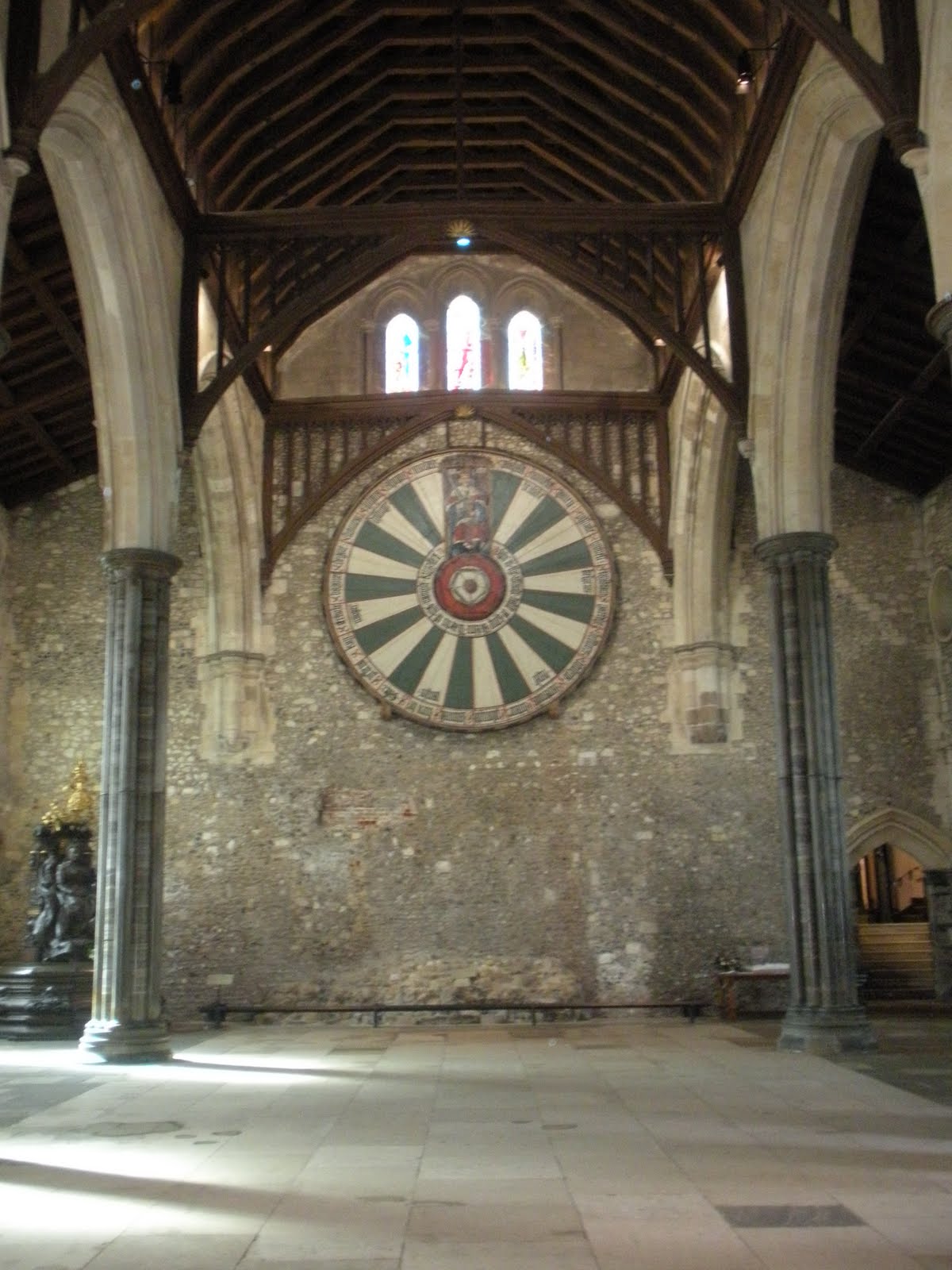
In 1522, Charles V visited England for six weeks. During the course of his stay, a betrothal was arranged between himself and the six-year-old Mary. As his arrival was celebrated in London, Henry VIII decided to take Charles to Winchester so he may see ‘King Arthur’s round table’. The table was constructed in the thirteenth-century by Edward III and painted in c.1516-7 (hence why King Arthur looks so like Henry!). Mary and Philip stayed in Winchester for several days after their wedding, and it is unknown whether Philip was show the table. However whilst Mary remained in seclusion following the wedding, Philip toured Winchester and it seems highly likely that he saw the town’s star attraction. The Great Hall remains a popular tourist site. Free to enter, it contains a magnificent set of nineteenth-century stained glass windows depicting the arms of individuals of importance to Winchester. Mary and Philip’s are included.


The Great Hall is free to enter and photography is permitted.


Westgate Museum


Westgate, one of the two surviving medieval fortified gateways in the city, is now a small museum and holds some interesting items. John White, Warden of Winchester College from 1542 to 1554, commissioned a splendid painted ceiling for his apartments that may have been ordered to celebrate Mary’s marriage. Mary and Philip visited the College after their wedding though it is unknown whether they saw the ceiling, or if it was specially made for the occasion.


Following conservation, the panels were given to the museum. Westgate also holds a portrait of Ralph Lamb, a wealthy resident of Winchester, who attended the wedding. The portrait is by an unknown Spanish artist and dates to c.1554, thus was commissioned to mark the event. He is probably depicted in the attire he wore for the occasion.


The museum is free to enter provides spectacular views of the city from the open rooftop.


[1] It is often stated that only one meeting took place. However one of Philip’s companions, Juan de Figueroa, mentioned another meeting at night.


(I have been working on the content for the Mary bibliography site, mentioned in my last post. I am not particularly computer savvy, so if anyone could give me some tips about which site I should use to create the website, I would be very grateful. Preferably something that I will find easy to use!)

Monday, 1 March 2010

Article by Prof. David Loades on 'King Philip of England'

A few months back I posted an article re-examining Mary’s reign by Professor David Loades, published in the BBC History Magazine. Here is another article by Professor Loades, but on Mary’s consort, Philip of Spain. The article was published in History Today (Jan 2007). Click on each image to enlarge and read.


Saturday, 20 June 2009

Contemporary ballad celebrating Mary’s ‘pregnancy’

Here is a sixteenth-century ballad, dating to Mary’s reign, that celebrates her ‘pregnancy’ of 1554-1555. The ballad, which I have posted here in the original early modern English, is evidently joyful in tone and regards the news of a prospective Catholic heir to indicate divine approval for Mary and her cause, and overall as a significant symbol of hope. The ballad also attacks those who are cynical of the news and who harbour malicious intentions. This was a reference to Protestant opponents who doubted that Mary could conceive and bear a living child. This ballad indicates a level of concern for such talk and also a sense of achievement as the supporters of the piece feel that Mary’s pregnancy ultimately means the end of the Protestant cause in England.


The ballad was designed to be sung and thus broadcasted to many. Such a way of spreading news was necessary in an age where most could not read. The ballad allowed for some individuals who were gifted in reading to memorise it, sing to others and they too could learn the lyrics and communicate it to others. The ballad was printed in London and perhaps the ballad was confined to this area, although the Council at this time was making sure that reports of the pregnancy were sent to bishops across the realm so they could tell the populace. Perhaps part of their campaign involved spreading literature like this across the country?


The Ballad of Joy,
upon the publication of
Q. Mary, wife of King Philip,
her being with Child,
Anno Dom(ni) .15- . [1]


Now singe, now springe, our care is exiled.
Our vertuous Quene is quickned with child.


Nowe englande is happie, and happie in dede,
That god of his goodness, dothe prospir here seede:
Therefore let us praie, it was never more nede,
God prosper her highnes, god send her good sped.
[2]


How manie good people, were longe in dispaire,
That this letel
(little) englane, shold lacke a right heire:
But nowe the swet marigold, springeth to fayre,
That England triumpheth, without anie care.


How manie greate thraldoms, in englande were seene,
Before that her highness, was pwblyshed
(published) as quene:
The bewtye
(beauty) of England, was banished clene,
With wringing, and wrongynge, & sorrowes betwen.


And yet synce her highness was planted in peace,
Her subjects wer doubtful of her highness increase
But nowe the recofort, their murmour doth cease,
They have their owne wyshynge
(wishing) their woes do release.


And suche as envied, the matche and the make
And in their proceedings, stoode styffe as a stake:
Are now reconciled, their malis doth slake,
And all men are wilinge, theyr partes for to take.


Our doutes be dissolved, our fancies contented,
The marriage is joyfull, that many lamented:
And suche as envied, like foles
(fools) have repented,
The errours & terrours, that they have invented.


But God dothe worke, more wonders then this,
For he is Auther, and Father of blysse:
he is the defender, his working it is,
And where he doth favoure, they fare not amys
(amiss).


Therefore let us praye, to the father of myght
To prosper her highness, and shelde her in ryghte:
With joye to deliver, that when she is lighte,
Both she and her people, maie Joye without flight.


God prosper her highnes, in every thinge,
Her noble spouse, our fortunate kynge:
And that noble blossome, that is planetd to springe,
Amen swete Jesus, we hartely singe.


Blysse thou swete Jesus, our comforters three,
Oure kynge, our Quene, our Prince that shal be:
That they three as one, or one as all three,
May govern thy people, to the plesure of thee.


Imprinted at London in Lumbarde strete
[3]
Signe of the Eagle, by
Wyllyam Ryddaell.


~~~~~~~~~~~~~~~~~~~~~~~~


[1] The year is not specified although it obviously dates to Mary’s 'pregnancy'. Her condition was widely known by November 1554, so this ballad must date to sometime after then and before early August 1555 (when Mary fully came out of confinement having realised that the pregnancy was not real).


[2] When the Queen Regnant (or as it had been before Mary, the Queen Consort) was pregnant, it was customary for Te Deums to be ordered in churches across the realm for the safety of the woman and child. Childbirth was notoriously dangerous in Tudor England and there were genuine concerns that Mary and/or her child could die. This provoked discussion about who would act as regent of the country if Mary died and the child lived, and it was decided that the role was Philip’s. However several drafts of the agreement concerning his regency had to be drawn up; the final act deemed that in the case of Mary’s death and the child’s survival, Philip would become de facto ruler of England until the child was of an age to rule. Mary supported this.


[3] ‘Lumbarde strete’, today known as Lombard Street, is situated south east of Gracechurch Street in the City of London. By 1556 only two printers were situated there compared to the fifteen that lived in St Paul’s Churchyard.

Monday, 25 May 2009

Medal commemorating the restoration of England to Catholic Communion, 1554 – and possibly Mary’s ‘pregnancy’?


In November 1554, England was officially received back to the Catholic Church. It was the moment Mary had been waiting for and to have this officially confirmed by Cardinal Reginald Pole, a leading churchman, Englishman and close friend of Mary’s, made the event even more significant. It was that month that Pole, after nearly twenty years of exile, returned to England as the papal legate. Mary wished to install him as her archbishop of Canterbury although Thomas Cranmer was still alive at this point thus Mary had to wait till his execution to bestow this on Pole. Nonetheless she did reverse the act of attainder that has been passed against him during Henry VIII’s reign in the parliament that met on the 12th November 1554 [1]. On the 22nd November, Pole landed at Whitehall, having travelled in the royal barge, and met Mary on the steps of the palace. She was accompanied by her new husband Philip and ‘she received him with great signs of respect and affection; both shed tears’ (Porter, p. 331).


The medal depicted here was struck to commemorate England’s return to Rome and Pole’s arrival in England to instigate this. Pole formally absolved the realm of past transgressions on St Andrew’s Day, 30th November, and the ceremony was greeted with much solemnity and emotion by Mary, Philip and the Commons. Mary had achieved the restoration of the old religious order; in the words of her biographer, David Loades, it ‘must have been the greatest moment of her life’ (p. 240). The medal captures this personal triumph.


The medal, made by the Paduan medallist Giovanni Cavino in 1554, depicts an allegorical scene. The symbolic figure of Anglia is depicted knelling before the pope and raising her hand forth, which he supports. By her is Pole wearing full cardinal attire, and to the right of Pole is the Holy Roman Emperor Charles V, who was Mary’s cousin, father-in-law and protector throughout much of her life. Charles had been deeply involved in organising Mary’s marriage to his son Philip and in supporting Mary’s decision to restore England to the Catholic Church, which resulted in his presence on the medal. To the right are Mary and Philip, both crowned. Mary’s eyes remain fixed on Anglia, whilst Charles and Philip look pleasantly on at Mary. Above the whole group are the words ‘ANGLIA RESURGES’ – ‘England, you shall arise’.


On the reverse of the medal is an image of Pope Julius III, the contemporary pope, who Mary enjoyed good relations with. Julius had confirmed Pole’s appointment to England and although he initially pressed for former monastic lands to be resorted to the Church, he eventually conceded that ‘it would be far better for all reasons human and divine, to abandon all the Church property [in England], rather than risk the shipwreck of this understanding’ (Whitelock, p. 247). Unfortunately for Mary, a prosperous relationship with the papacy would eventually cease in the last years of her reign owing to the anti-Habsburg policies of Paul IV. [2]


The commemorative tone of the medal is notable. However there is another message, one which is subtle and hopeful. This can be seen in the figure of Mary. Although it is hard to completely establish Mary’s physique owing to the baggy nature of her dress, it is evident that she is depicted with a round stomach which she draws attention by laying her hand upon. All books that I have come across that include an image of this medal overlook the possibility that the medal is also drawing attention to Mary’s ‘pregnancy’ of 1554/1555. Yet it was around the time of the ceremonies which installed England back to the Catholic Church that Mary confirmed her condition. Personal confirmation came on the very day when she greeted Pole on the steps of Whitehall. His first words upon seeing her were, ‘Hail, thou art highly favoured, the Lord is with thee: blessed are thou among women’. Pole later retired and was subsequently greeted by one of Mary’s messengers who claimed that the queen had felt the child in her womb quicken when Pole had spoken the words to her. Quickening, the first moments of the child in the womb, was regarded as a confirmation of pregnancy in the early modern period and also a sign that the child was still alive. For Mary, the possibility of a Catholic heir was a joyous prospect and meant the security of her religious policies. Hence allusions to her pregnancy were entirely appropriate on a medal celebrating England’s return to the Catholic Church. Her condition was made widely known by the end of that month, again indicating the possibility that this medal, created near the end of that year, was purposely drawing attention to her pregnancy.


Unfortunately for Mary, the joy turned to despair when the pregnancy revealed itself to be fake in the summer of 1555 [3]. And with this came significant concerns about the succession and thus the sustainability of her religious policies. However references to the future worries about the succession that would plague the rest of Mary’s reign are practically nonexistent in this insightful medal from Mary’s Annus Mirabilis.


The medal has been recently included in Eamon Duffy, Fires of Faith: Catholic England under Mary Tudor (New Haven and London, 2009), plate 4.


~~~~~~~~~~~~~~~~~~~~~~~~~~~~~~~~~~~~

[1] The bill of attainder against Reginald Pole was passed on the 19th May 1539. In January of that year his brother, Henry, Baron Montagu had been executed for allegedly plotting against Henry VIII (and he too was included in the bill along with their mother, Margaret Pole). Reginald Pole was in the Observant Franciscan house of Montili at Carpentras when this occurred.

[2] Divisions between Paul IV and Mary were also created when the Pope pressed for Pole to be sent to Rome to be tried on charges of heresy. Mary ultimately refused and her refusal to do so contributed to Paul IV’s demonstrations of gratification when he learnt of her death in November 1558.

[3] Limited work has been done into Mary’s ‘pregnancies’, although historians mostly agree that she suffered from cases of pseudocyesis, otherwise known as ‘phantom pregnancy’, whereby an individual exhibits signs of pregnancy but is ultimately not pregnant. For an interesting discussion into the possible biological and psychological causes of this see Judith Richards, Mary Tudor (Oxon, 2008), p. 173.


References

Eamon Duffy, Fires of Faith: Catholic England under Mary Tudor (New Haven and London, 2009), pp. 43-5, plate 4.
David Loades, Mary Tudor: A Life (Oxford, 1992), pp. 237-40.
Linda Porter, Mary Tudor: The First Queen (London, 2007), p. 331-33.
Judith Richards, Mary Tudor (Oxon, 2008), pp. 169-73.
Anna Whitelock, Mary Tudor: England’s First Queen (London, 2009), pp. 247-53.